
Table of Contents
If you’re looking for free online courses in bioinformatics, you’ve probably already run into the same problem a lot of students do: your degree teaches you the biology, but almost nobody teaches you the computing. And more and more jobs, and PhD programs, expect both.
National Programme on Technology Enhanced Learning (NPTEL), run jointly by the IITs and IISc, quietly solves this. It’s free to learn from, and if you want proof of what you learned, you can sit a proctored certification exam for ₹1,000 for which you can register yourself at Swayam Portal. That’s it. No expensive bootcamp, no vague “certificate of completion” that means nothing to an admissions committee. Just a real course, taught by faculty at some of India’s best research institutes, with a certificate that carries their name.
NPTEL currently runs 21 courses under its Computational Biology domain, and this is the full list, grouped below by what they’ll actually teach you. Whether you’re a first-year undergrad or a PhD applicant, one of these free online courses in bioinformatics is probably relevant to you. Each one has the real course link, so you can go straight to enrolling.
How the NPTEL Certification Exam & Free Model Works
- Learn for free. Every course here comes with full video lectures, notes, and assignments, at no cost.
- Certify for ₹1,000. When a course’s enrollment window opens, you can register for the NPTEL certification exam for a flat ₹1,000. Assignment scores plus exam performance decide your final grade and certificate.
- The certificate is real. It carries the instructor’s name and their institute (IIT Madras, IISc Bangalore, IISER Bhopal, and so on), and it’s e-verifiable through NPTEL. That matters if you’re applying to a PhD program or handing your CV to a recruiter who’s seen a hundred generic “online course” certificates before.
Eligibility criteria to join these free online courses in bioinformatics
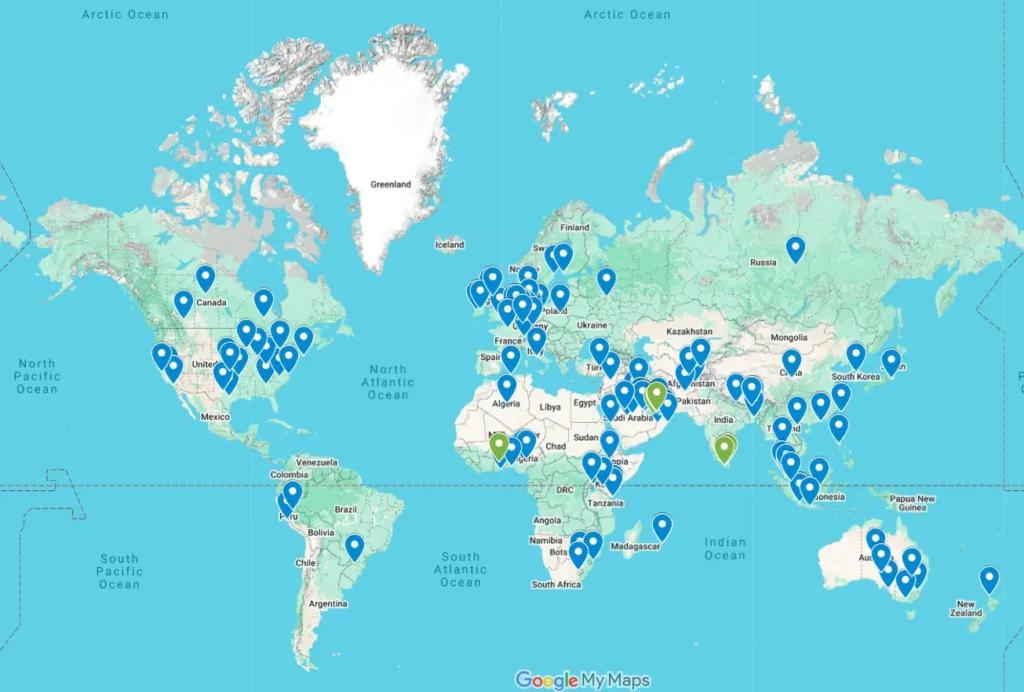
These free online courses in bioinformatics courses can be taken up by any life science graduate, post-graduate, PhD, or Post-PhD student/professionals who wants to upskill their knowledge of bioinformatics from anywhere in the globe. These courses are available for life science researchers around the world and provides an opportunity to learn from one of the best premier institutes in India. If you are someone from outside of India (a foreign student) you can still get the certification for these courses as the proctored exams are available in around 133 cities around the world.
If you’re a foreign life science student from the US, Canada, the UK, China, Russia, Brazil, Afghanistan, Bangladesh, Nepal, Nigeria, Saudi Arabia, Australia, Singapore, Turkey, South Africa, Europe, or any other country on NPTEL’s eligible list, you can get certified for very little money. It’s a cheap way to add a real skill to your resume. To get the detailed list of all the exam cities where these online proctored exams could be undertaken visit this link- Exam centre sites outside of India.
1. Programming & Data Science Foundations Courses Online
Start here if you want the computing skills that most of the courses below quietly assume you already have.
a) Programming, Data Structures and Algorithms Using Python
Duration: 8 Weeks | Prof. Madhavan Mukund | Chennai Mathematical Institute Course link
This is genuinely a from-zero course. No programming background assumed. It works through Python basics, then into searching and sorting algorithms, dynamic programming, backtracking, and Python-specific data structures like dictionaries, linked lists, and binary search trees. If you’ve never written code before, start here before touching anything else on this list.
b) MATLAB Programming for Numerical Computation
Duration: 12 Weeks | Prof. Niket Kaisare | IIT Madras Course link
MATLAB still shows up constantly in systems biology and biomedical modeling labs, and this course teaches numerical computation from scratch using it, with access to MATLAB Online included for enrolled students. Good pick if your lab or program leans MATLAB rather than Python.
c) Introduction to R Software
Duration: 8 Weeks | Prof. Shalabh | IIT Kanpur Course link
R runs most bioinformatics and biostatistics pipelines, and this course gets you fluent in its basics, mathematical operations, and statistical functions. Pair it with the R course below once you’re comfortable here.
d) Biological Data Analysis and Visualization with R
Duration: 8 Weeks | Prof. Riddhiman Dhar | IIT Kharagpur Course link
This picks up where basic R leaves off and applies it specifically to biological data, everything from foundational statistics to more advanced applications like ChIP-seq analysis and regression models. Officially lists Introduction to R Software as a prerequisite, so do that one first.
e) Data Analysis for Biologists
Duration: 8 Weeks | Prof. Biplab Bose | IIT Guwahati Course link
Built specifically for biology students who need to go beyond classical statistics into the clustering, classification, and dimensionality reduction techniques that modern high-throughput data demands. If your undergraduate stats training stopped at t-tests, this fills the gap.
2. Genomics and Sequencing Courses Online (Omics)
If you’re specifically hunting for genomics courses online, this is the core cluster: sequencing, genome-scale analysis, and the omics techniques built on top of them.
a) Next Generation Sequencing Technologies: Data Analysis and Applications
Duration: 12 Weeks | Prof. Riddhiman Dhar | IIT Kharagpur Course link
Walks through the full NGS analysis pipeline: data quality checks, read mapping, SNP and indel identification, RNA-seq normalization and differential expression, gene set enrichment, and genome assembly. If your lab hands you processed spreadsheets from a sequencing core and you’ve always wondered what happens before that point, this answers it.
b) Computational Genomics
Duration: 12 Weeks | Prof. Vineet Kumar Sharma | IISER Bhopal Course link
Taught by someone whose lab has sequenced genomes for the Indian tiger, peacock, and several native cattle breeds, this course builds the concepts behind genome-scale analysis and the algorithms used to make sense of large-scale biological data.
c) Advances in Omics
Duration: 8 Weeks | Prof. Nagarjun Vijay | IISER Bhopal Course link
Starts with the history of the Human Genome Project and how it drove the development of next-generation sequencing, then moves into the wider omics landscape. Good for getting the big picture before you specialize into any one omics field.
d) Introduction to Proteogenomics
Duration: 12 Weeks | Prof. Sanjeeva Srivastava | IIT Bombay Course link
Developed in part with the Broad Institute of MIT and Harvard, this course focuses on combining proteomic and genomic data to find actionable targets in cancer research, with real case studies and hands-on sessions on gene set enrichment, biological network analysis, and supervised machine learning for biomarker discovery.
e) Functional Genomics
Duration: 4 Weeks | Prof. S. Ganesh | IIT Kanpur Course link
A short course tackling a real gap in modern biology: we can sequence genomes fast, but figuring out what most genes actually do is still hard. Covers forward and reverse genetics approaches and how NGS gets applied to answer functional questions. Low time commitment if you want to sample the genomics track first.
f) Comprehensive Molecular Diagnostics and Advanced Gene Expression Analysis
Duration: 12 Weeks | Prof. Aritri Bir and Prof. Arindam Ghosh | IIT Kharagpur Course link
Covers molecular diagnostic methods from PCR through NGS and CRISPR-Cas9, with a clear clinical lens, applications in infectious disease, cancer, and genetic testing. Aimed partly at working medical lab professionals, so it’s a solid pick if diagnostics or translational medicine is where you’re headed.
3. Computational Biology Courses Online & Systems Biology
This is the largest cluster on the list, and probably the one most people mean when they search for computational biology courses online: algorithms, modeling, and simulation applied directly to biological systems.
a) BioInformatics: Algorithms and Applications
Duration: 12 Weeks | Prof. Michael Gromiha | IIT Madras Course link
A genuine foundational bioinformatics course: sequence databases, structural analysis, protein structure and folding rate prediction, and computer-aided drug design through docking and QSAR. Taught by one of the more established names in Indian bioinformatics research. If you want one course that gives you the field’s theoretical spine, this is it.
b) Algorithms in Computational Biology and Sequence Analysis
Duration: 12 Weeks | Prof. Chirag Jain | IISc Bangalore Course link
More CS-flavored than most courses on this list, this one is built for people who want to design the algorithms behind bioinformatics tools rather than just use them, and it includes hands-on exercises using real SARS-CoV-2 genome data. Best fit if your instinct leans toward computer science or applied math.
c) Computational Systems Biology
Duration: 12 Weeks | Prof. Karthik Raman | IIT Madras Course link
Covers mathematical modeling of metabolic, signaling, and regulatory networks, dynamic modeling with ODEs, parameter estimation, and constraint-based metabolic modeling, with a genuinely hands-on component. Good fit if you’re interested in how cells behave as systems rather than as collections of individual parts.
d) Introduction to Dynamical Models in Biology
Duration: 4 Weeks | Prof. Biplab Bose | IIT Guwahati Course link
A short, math-forward course on using ordinary differential equations to model biological processes like cell signaling and transcriptional circuits. It assumes you’ve studied biochemistry and molecular biology at the graduate level and math up to class 12, so it’s a step up rather than a starting point.
e) Computational Neuroscience
Duration: 12 Weeks | Prof. Sharba Bandyopadhyay | IIT Kharagpur Course link
Starts from the basics of quantifying neuronal activity and modeling how single neurons fire, then builds toward how the brain represents and reads out information. Relevant if you’re drawn to neuroscience, cognitive science, or the current overlap between neuroscience and AI research.
f) Algorithms for Protein Modelling and Engineering
Duration: 12 Weeks | Prof. Pralay Mitra | IIT Kharagpur Course link
Digs into the algorithms behind existing protein modeling software, so you can actually customize the tools instead of just running them as black boxes, covering protein-protein docking, structure prediction, and protein design. Increasingly relevant given how central tools like AlphaFold have become to structural biology.
g) Computational Quantum Chemistry
Duration: 12 Weeks | Prof. Achintya Kumar Dutta | IIT Bombay Course link
The most chemistry-heavy course on this list, teaching you to simulate chemical properties using ORCA, a free quantum chemistry software package, covering both the theory and the practical side of setting up and interpreting real calculations. A solid pick if you want to understand what’s actually happening underneath computational drug design tools.
4. Drug Discovery & Machine Learning
a) Computer Aided Drug Design
Duration: 8 Weeks | Prof. Mukesh Doble | IIT Madras Course link
Walks through the actual drug discovery pipeline, week by week: structure and property prediction, ADME rules, force fields, molecular docking, QSAR and pharmacophore modeling, and pharmacokinetics. Taught using free, publicly available software, so there’s no licensing wall between you and trying it yourself.
b) Artificial Intelligence in Drug Discovery and Development
Duration: 12 Weeks | Prof. Rajnish Kumar | IIT (BHU) Varanasi Course link
Picks up where the drug design course leaves off and adds AI and ML on top: predictive modeling, generative AI-based drug design, and drug repurposing, with hands-on tutorials throughout. Given how fast pharma R&D is adopting AI right now, this is one of the more future-facing courses here.
5. Statistics for Biomedical Research
a) Statistics for Biomedical Engineers
Duration: 12 Weeks | Prof. Babji Srinivasan | IIT Madras Course link
Covers biostatistics from the ground up: probability theory, statistical inference, and experimental design methods used in clinical trials, health surveys, and intervention studies. Worth doing if your work touches clinical, physiological, or biomedical device data specifically.
How to Pick Where to Start
You don’t need all 21. A reasonable way to narrow it down:
- New to coding? Python or R fundamentals come first, before anything else here.
- Aiming at genomics or wet-lab research? NGS, Computational Genomics, and Functional Genomics are the highest-leverage picks.
- Leaning toward pharma or drug discovery? Computer Aided Drug Design, then AI in Drug Discovery, is a natural sequence.
- Applying for a PhD? Pick one or two courses that actually match your target lab’s methods. A certificate that lines up with your statement of purpose does more work than a stack of unrelated ones.
Final Thoughts
₹1,000 for a certificate carrying an IIT, IISc, or IISER name is a genuinely good deal, maybe one of the best available to Indian biology students right now. Of all the free online courses in bioinformatics out there, this NPTEL list is about as legitimate as it gets. Pick the one course from this list that matches where you actually want to go next, and start this week rather than bookmarking it for later.
If you are a post-graduate student and preparing for GATE-Life Science, GATE-Biotechnology you can read/download previous years papers to prepare for the exam from here- TheBiologyBro Past Papers for GATE
Free Test series for Graduate and Post graduate students are available here- TheBiologyBro Academy
Frequently Asked Questions (FAQs)
What are the best free online courses in bioinformatics right now?
NPTEL’s 21-course computational biology lineup, covered above, is the most comprehensive set of free online courses in bioinformatics currently available from Indian institutes. It spans everything from Python and R fundamentals to genomics, drug design, and computational neuroscience, taught by faculty at IIT Madras, IIT Kharagpur, IISc Bangalore, IISER Bhopal, and others.
Are NPTEL courses actually free, or is there a hidden cost?
The courses themselves, video lectures, notes, and assignments, are completely free to access and complete. The only cost is optional: if you want an official certificate, you register for the NPTEL certification exam for a flat ₹1,000. Skip the exam and you can still learn everything for free, you just won’t have a certificate to show for it.
Are these free online courses in biology recognized by universities or employers?
Yes. NPTEL is a joint initiative of the IITs and IISc, and its certificates are e-verifiable and widely recognized across Indian academia and industry. They’re commonly listed on CVs and used to support PhD and postdoc applications, particularly when the course content lines up with the applicant’s target research area.
Do I need a programming background to take these computational biology courses online?
No, not for all of them. Programming, Data Structures and Algorithms Using Python assumes zero prior coding experience and is designed as a starting point. A few of the more advanced courses, like Algorithms in Computational Biology and Sequence Analysis, do expect basic algorithms and discrete math knowledge, so check each course’s stated prerequisites before enrolling.
How do I enroll in genomics courses online through NPTEL?
Each course listed above links directly to its NPTEL course page. From there, you register for the course during its open enrollment window (courses rerun on a rolling semester schedule), watch the lectures and complete assignments at your own pace, and then separately register for the proctored certification exam if you want the certificate.
How long does it take to complete a free bioinformatics course on NPTEL?
Course length varies from 4 to 12 weeks depending on the subject. Shorter options like Functional Genomics (4 weeks) or Introduction to Dynamical Models in Biology (4 weeks) are good if you want a lower time commitment, while most of the genomics and systems biology courses run the full 12 weeks.
Will an NPTEL certificate actually help with a PhD or postdoc application?
It can, if you pick strategically. A generic certificate does little on its own, but a certificate in a method your target lab actually uses, say, Computational Genomics before applying to a genomics-focused group, signals genuine, demonstrable interest and skill. Admissions committees notice relevance more than volume.